NCP’s Zero Trust VPN solution for security, control, and data sovereignty
Zero Trust follows a simple principle: Never trust, always verify. Every request to access an application or resource is continuously verified and evaluated against defined security policies. A modern Zero Trust architecture therefore protects access regardless of whether it originates from the corporate network, a home-working environment, or another remote location.
Zero Trust does not necessarily replace a VPN. Zero Trust and VPN technology can complement one another as part of a flexible, modern security architecture. Zero Trust Network Access, or ZTNA, enables targeted, policy-based control over access to individual applications and resources.
Whether your organization relies on cloud-based services, maintains a highly secure on-premises environment, or uses a hybrid IT infrastructure, NCP Zero Trust software supports a range of deployment scenarios. It helps you combine strong security and operational flexibility while retaining control over your data and infrastructure.




What is Zero Trust, and how does it work?
Zero Trust shifts the focus from the network as a whole to each individual request for access to an application or resource.
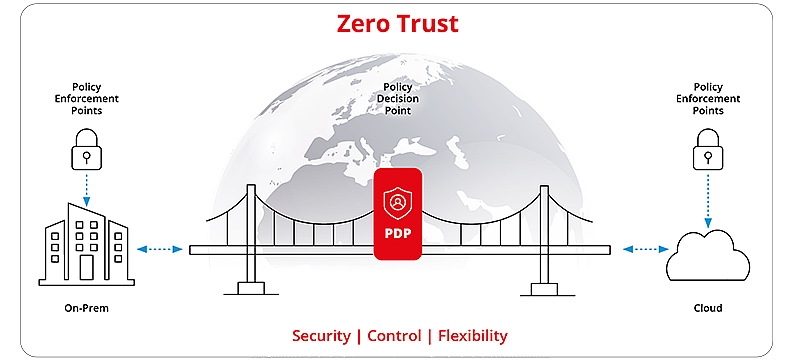
Two components are central to this approach:
The Policy Decision Point (PDP) evaluates access requests against defined security policies. The Policy Enforcement Points (PEPs) technically enforce the PDP’s decisions. This creates an architecture in which an access request is never considered trustworthy based solely on network membership.
Zero Trust Agent & Zero Trust Gateway
| Category | Information |
|---|---|
| Product type | Zero Trust Agent/Zero Trust Gateway |
| System architecture |
|
| Additional features |
|
Zero Trust Management
| Category | Information |
|---|---|
| Product type | Centralized, database-driven management system |
| System architecture | Management server with a graphical management interface |
| Managed components | Zero Trust Agents/Zero Trust Gateways, Management Server |
| User management | Integration with identity providers through OAuth 2.0 and with existing user and directory services, including Microsoft Active Directory and Microsoft Entra ID |
| Management functions | Configuration of clients, gateways, and the management server, as well as multi-tenant administration |
| Additional features |
|
Why use the NCP Zero Trust solution?
Because modern IT security does not end with Zero Trust. NCP combines Zero Trust with proven VPN and remote-access technology, providing a sovereign and flexible solution that can be integrated gradually. This allows organizations to protect access to individual applications and resources without having to replace their entire existing infrastructure.
NCP Zero Trust software allows you to secure access selectively, retain control over your IT environment, and strengthen your data sovereignty. Its flexible Zero Trust architecture adapts to your existing infrastructure — from cloud and on-premises systems to complex hybrid environments.
Your Benefits with NCP
- Granular access control: Every access request is verified and selectively authorized according to defined security policies.
- Data Sovereignty: Retain control over security decisions, infrastructure, and data.
- Cloud and on-premises deployment: Implement a flexible Zero Trust architecture suited to your individual IT environment.
- Security without the cloud: Use ZTNA even in isolated on-premises environments without requiring a cloud or internet connection.
- Made in Germany: Benefit from software developed in Germany and direct support from the manufacturer.
- Zero Trust and VPN: Easily continue using and augment existing VPN infrastructures.
Take the next step
Would you like to implement Zero Trust in your IT environment while continuing to make effective use of your existing infrastructure? We will help you select the right deployment scenario and guide you towards a secure, flexible Zero Trust architecture.
Contact our Team for Zero Trust
Dombuehler Str. 2
90449 Nuremberg
+49 911 9968 333
sales@ncp-e.com
Frequently asked questions
Find concise answers to common questions about Zero Trust, possible deployment scenarios, and NCP’s approach.
NCP combines a modern Zero Trust architecture with decades of experience in secure remote access and VPN technology. Organizations can continue using their existing infrastructure and introduce Zero Trust gradually—on-premises, in the cloud, or as part of a hybrid environment.
No. NCP Zero Trust can also be deployed on-premises, with the Policy Decision Point (PDP) operating within the organization’s own infrastructure. This makes the solution suitable for environments with stringent requirements for control, isolation, and data sovereignty.
Yes. NCP Zero Trust software is designed to integrate with existing network and remote-access environments. Organizations can develop their Zero Trust architecture gradually without having to replace their entire existing infrastructure at once.
Yes. The Policy Decision Point (PDP) can be operated within the organization’s own infrastructure. This makes the solution suitable for environments with particularly stringent requirements for control, isolation, and data sovereignty.
Yes. NCP Zero Trust can be deployed in cloud, private cloud, on-premises, and hybrid environments. This allows the Zero Trust architecture to be adapted to an organization’s individual requirements and existing IT landscape.
NCP Zero Trust is suitable for businesses and public organizations that want to protect access to individual applications and enhance their existing remote-access infrastructure. The solution is particularly relevant for hybrid IT environments and organizations with stringent security, control, and data sovereignty requirements.
Access is not granted based solely on successful authentication. Factors such as identity, device status, context, and defined security policies can also be taken into account. This information is evaluated to determine whether access to an application should be permitted and, if so, under which conditions.
VPN and IPsec can continue to form part of the overall security architecture. They provide secure connections between endpoints, networks, and locations, while Zero Trust mechanisms apply targeted controls to access individual applications and resources. This allows organizations to combine proven network security technology with modern, policy-based access controls.
Organizations do not need to transform their entire IT environment at once. NCP supports a gradual approach in which existing remote-access and VPN infrastructure remains in use while Zero Trust capabilities are introduced progressively.

Do you have questions?
Our team will be happy to advise you personally.
Dombuehler Str. 2, 90449 Nuremberg
+49 911 9968 333
sales@ncp-e.com